
Hidalgo County Crime News and Records
There is no single county crime blotter for Hidalgo County. So start with local outlets and the agencies they quote. KRGV maintains a Hidalgo County tag that rounds up its regional coverage, and it is probably the strongest local landing page. MyRGV and The Monitor handle crime and courts one article at a time. ValleyCentral also runs a regional news page. Its deeper navigation can be limited, so browse it live rather than assuming a narrow section exists. Most stories name their source somewhere in the text.
That attribution matters. It tells you whether the information came from the Sheriff's Office, a city department in McAllen, Edinburg, or Mission, a court filing, or a county record. Write down the agency and the date. Then take both to the Hidalgo County Records Inquiry. That portal splits its offerings into Jail Records, Jail Bond Records, Criminal Case Records, and Court Calendar. A custody question, a bond question, and a court question each lead somewhere different.
Hidalgo County Media and Mugshot Sources
Coverage picks and chooses. A TV segment might run an agency-supplied photo. It might use no photo at all. Or it might get rewritten as a case develops. Third-party county pages can help you discover a lead, but they keep no records of their own and can hold stale, incomplete, or mismatched material. Official sources rank first in the table for a reason. They control the booking and arrest records everyone else borrows from.
| Outlet or source | Coverage | Photos and record path |
|---|---|---|
| Hidalgo County Sheriff’s Office | Official agency identity, public-safety statements, and social links. | Not a verified complete arrest-photo archive. Use HCSO’s record route for booking material. |
| Hidalgo County Records Inquiry | Official jail, bond, criminal-case, and calendar searches. | A result may include an available booking photo, but no universal public-photo guarantee was found. |
| KRGV | Regional Hidalgo County news and arrest reporting. | May use agency-supplied images. Check the cited agency and official record. |
| MyRGV / The Monitor | Local news, crime, and court reporting by article. | Not a booking ledger; article sourcing and dates matter. |
| ValleyCentral | Regional local-news coverage. | Verify the current navigation and any agency attribution before relying on a story. |
| Busted Newspaper, RecentlyBooked, and Arrests.org | Unofficial county sections. | Secondary discovery pages only. They can be stale, partial, or wrong and require official verification. |
Two more county-level third-party sources are Mugshots.zone and RGVBookings. Neither answers to Hidalgo County. Neither controls how listings are updated or removed. Treat both as leads rather than records. Anything found there should be confirmed against the official portal, a written request, or the court file, with attention to the person, the date, and the custody status. The KRGV Hidalgo County tag appears below as a news navigation aid, not as a booking-photo database.
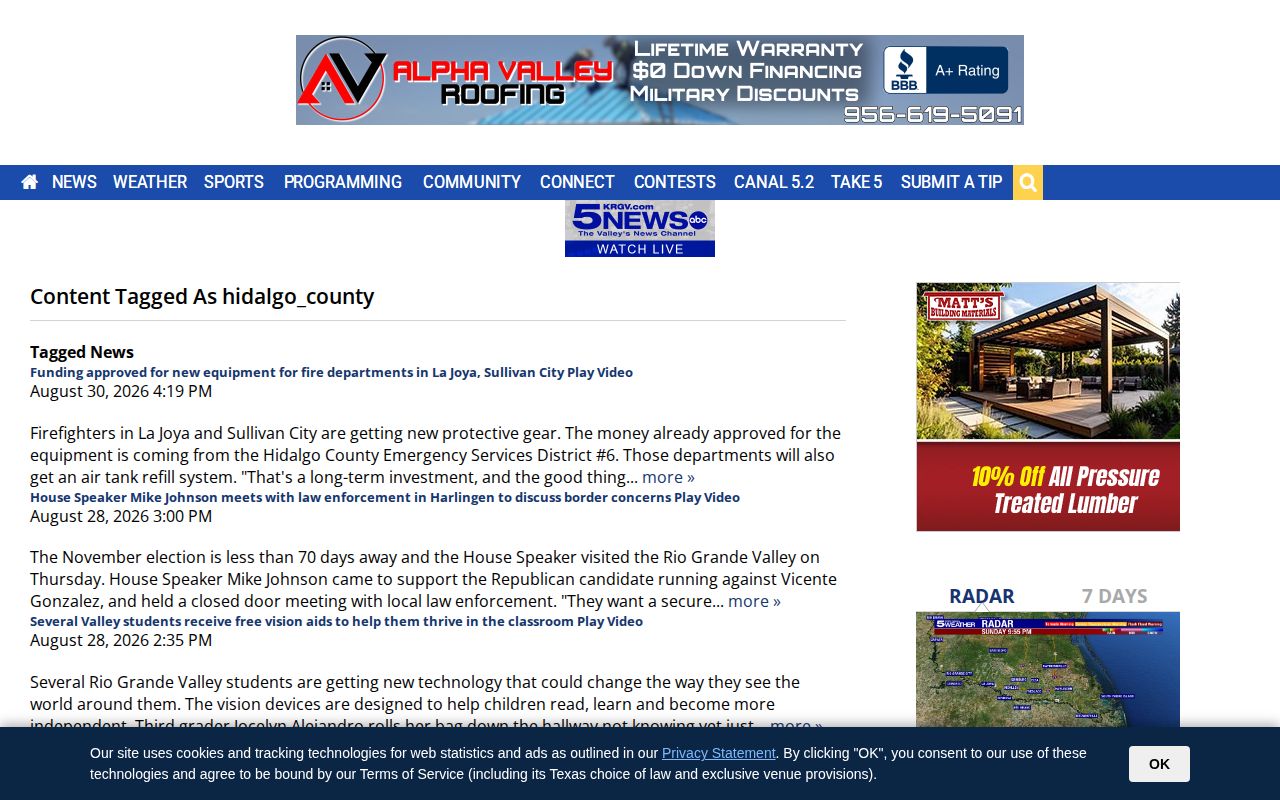
A named agency is your better next stop. If the report points to HCSO, a city department, or a court, go there. A headline's date can never stand in for the date and status written in the official record.
How Hidalgo County Photos Reach News
Where do news photos come from? Usually a police department, the sheriff's office, or county records released the image. But the story built around it is still just a story. Hidalgo County's public-information FAQ names HCSO as the custodian for mugshots and jail bookings. It points requesters to written petitions under the Texas Public Information Act. The official portal shows an image only when one is attached and released. Nothing in county policy promises a photo for every entry.
Texas Government Code Chapter 552 frames all of this, with exceptions. A local illustration is Hidalgo County Attorney General ruling OR2011-09526. It dealt with booking photos and a jail/arrest log. It shows how fact-specific release can be. Law-enforcement interests, privacy, juvenile confidentiality, sealed matters, and other statutes can each change what a custodian hands over. So a missing photo, by itself, tells you almost nothing about whether a booking happened.
One more law applies to publishers. Texas Business & Commerce Code Chapter 109 regulates certain criminal-record sites that charge fees around corrections or removals. It does not turn news images into official records or make every photo private. If something published is wrong, start with the source agency or court. Then use the publisher's free correction route where the law requires one. No paid removal service is recommended here.
Note: A booking image documents a booking event, not anything the court later decided.
Newsrooms choose what to cover and which images to run. No story does not mean no arrest. A story can also linger online long after a charge changes or a case closes. For reliable dates, the agency record and the court file beat the archive every time.
From Hidalgo County Story to Official Record
A news story hands you the raw material for a records search. You get a spelled-out name, the arresting agency, a booking or arrest date, and sometimes the court involved. Skip the urge to trust the headline. Feed those details into the right record layer. Then compare dates and identifiers so the result actually belongs to the person you are looking for.
- Save the story’s date, named agency, jurisdiction, and any case or cause number without assuming they prove the claim.
- Search the county’s official Jail Records option for a current or recent Hidalgo booking, and confirm more than a name.
- When a city police agency made the arrest, request its report from the records office if that is the record needed.
- Use Criminal Case Records and Court Calendar in Records Inquiry to find the court path, then the County Clerk or District Clerk for copies as appropriate.
- Read the disposition or later filing before repeating an charge as an outcome.
The full chain of county searches, booking requests, rosters, and recent-arrest fallbacks sits on Hidalgo County's booking and records reference. City sources add municipal context too: McAllen's records route, Edinburg police records, and Mission's city records path each run separately from what HCSO holds on custody.
Hidalgo County Arrest Feed Limits
Hidalgo County does not publish a rolling booking feed. The sheriff's office has no same-day, 24-hour, 48-hour, or 72-hour arrest log. There is no weekly version either. No archive exists. What the county offers instead is a search interface. A new arrest may sit behind the scenes for a while as it moves through magistration, data entry, transfer, or release. So timing gets messy fast. A news story can surface before any jail result shows up online, and a jail result can appear with no news coverage at all. Neither order tells you anything about a fixed posting schedule.
When a recent event is nowhere online, go straight to the agency that made the arrest. Try the live county search too. If a booking record or photo should exist but does not show, the HCSO written-request route is the fallback. City police departments often keep their own incident and arrest reports, even when the county portal has no matching image. For older events, a dated court record or a specific written request beats any assumption that an online archive exists somewhere.
Hidalgo County Court Follow-Up
A booking entry is only the start of a story. After intake, a magistrate may set bond, issue warnings, or impose conditions. Prosecutors then get a turn. They can investigate further, amend charges, decline them, or push the case ahead. From there a person might plead, stand trial, win acquittal, see the case dismissed, or be convicted. The jail record stays on the books even after the court resolves things differently.
That is why the county portal keeps jail and court records apart. For county-level criminal matters, the County Clerk is the custodian to contact. The District Clerk holds the district-court files, which include felonies. Let the court and cause number on the official result guide your next request. A jail photo is rarely attached to a court file, and a court record will not repeat every jail field.
Why check the court? Charges filed at intake often look very different by the time a case ends, and only the court file shows where it actually landed.
Share local stories responsibly. Keep the source and the date attached. Name where the material came from, whether a city agency, HCSO, a court, or a newsroom. That habit lets readers verify a claim instead of treating a headline or thumbnail as the final word on a person. For sealed or expunged records, rely on the court and its custodian rather than an old news item or third-party site.